
Lorenzo Marrucci
Professor of Physics · Head of the SLAM research cluster
Email: lorenzo.marrucci@unina.it
Office phone: +39 081 676124
Room: 2H-10 (building 6)
Mailing address
Dipartimento di Fisica “Ettore Pancini”
Complesso Universitario di Monte S. Angelo
Via Cintia, 80126 Napoli, Italy
Google Scholar profile · Web of Science profile
Curriculum vitae (PDF) · Publications
Research
My research focuses on structured light and its interaction with matter. My interests span the angular momentum of light, quantum and nonlinear optics, and condensed matter physics, particularly transition-metal oxides and liquid crystals. I invented the q-plate, a device that uses spin–orbit coupling to generate light carrying orbital angular momentum.
Informazioni per gli studenti (information for students, in Italian)
Link al sito docente UNINA (info su corsi, esami e altro): https://www.docenti.unina.it/lorenzo.marrucci
Ricevimento: L’orario settimanale di ricevimento è riportato nel sito docente, ma capita spesso che sia costretto a cancellarlo per altri impegni concomitanti, quindi è fortemente raccomandato di contattarmi preventivamente via email, telefono o MS Teams per verificare la mia effettiva disponibilità. Al di fuori dell’orario riportato, e anche nei periodi in cui non ci sono i corsi, sono comunque pienamente disponibile a ricevere gli studenti in qualsiasi giorno/orario su appuntamento (telefonatemi o mandatemi una e-mail o messaggio Teams per accordarci), oppure anche senza preavviso se in quel momento non sono impegnato.
Tesi di laurea e dottorato di ricerca: Sono quasi sempre disponibili tesi di laurea, laurea magistrale e dottorato di ricerca in quasi tutte le attività di ricerca descritte nelle pagine web del cluster di ricerca SLAM. Di norma l’attività prevista per tali tesi è prevalentemente sperimentale. Come è tipico per la ricerca in ottica, attività quali la progettazione e il montaggio degli esperimenti, l’analisi dati, e la modellazione dei risultati sono tutte svolte da noi in prima persona. Occasionalmente è possibile anche svolgere tesi di tipo interamente teorico.
Publications
Notice: when links to PDF files are available, these files are usually copyrighted and may be downloaded for personal use only; any other use requires prior permission of the author and/or the publisher. For open access papers only the link to the publisher page is provided, as the file can be downloaded there. For other papers, you can contact the author to ask for a reprint.
View publication list
2026
Maria Gorizia Ammendola; Italo Machuca Flores; Sneha Dey; Francesco Di Colandrea; Andrei Nomerotski; Bereneice Sephton; Carlo Schiano; Corrado Lisio; Vincenzo D’Ambrosio; Lorenzo Marrucci; Patrick Cameron; Filippo Cardano
Tunable quantum interference in free space with a liquid-crystal metagrating Journal Article
In: OPTICA QUANTUM, vol. 4, no. 4, pp. 374–381, 2026.
@article{ammendola_tunable_2026,

title = {Tunable quantum interference in free space with a liquid-crystal metagrating},

author = {Maria Gorizia Ammendola and Italo Machuca Flores and Sneha Dey and Francesco Di Colandrea and Andrei Nomerotski and Bereneice Sephton and Carlo Schiano and Corrado Lisio and Vincenzo D’Ambrosio and Lorenzo Marrucci and Patrick Cameron and Filippo Cardano},

url = {https://doi.org/10.1364/opticaq.597375},

doi = {10.1364/opticaq.597375},

year  = {2026},

date = {2026-08-01},

urldate = {2026-08-01},

journal = {OPTICA QUANTUM},

volume = {4},

number = {4},

pages = {374–381},

abstract = {Structured optical materials provide a promising platform for photonic quantum information processing in free space. Beam splitters, a fundamental building block of photonic circuits, have recently been demonstrated in free space using geometric-phase optical elements. These devices coherently mix circularly polarized transverse modes of freely propagating optical fields, including modes carrying orbital angular momentum. In this work, we investigate liquid-crystal metagratings as electrically tunable beam splitters for transverse-momentum optical modes. By exploiting the voltage-controlled birefringence of liquid-crystal metasurfaces, we experimentally tune the splitting ratio of the device and thereby control the degree of two-photon interference between indistinguishable photons. At the output, photons are spatially resolved in different regions of a time-resolved single-photon-sensitive detector, enabling the reconstruction of coincidence maps in the Fourier plane. This approach is readily scalable and enables highly parallel coincidence measurements across a large number of optical modes.},

keywords = {},

pubstate = {published},

tppubtype = {article}

}
Patrick Cameron; Francesco Di Colandrea; Filippo Cardano; Lorenzo Marrucci
Evidence for Counterfactual Violation of Local Conservation Laws in Quantum Events Working paper
2026, (arXiv:2608.09205 [quant-ph]).
@workingpaper{cameron_evidence_2026,

title = {Evidence for Counterfactual Violation of Local Conservation Laws in Quantum Events},

author = {Patrick Cameron and Francesco Di Colandrea and Filippo Cardano and Lorenzo Marrucci},

url = {http://arxiv.org/abs/2608.09205},

doi = {10.48550/arXiv.2608.09205},

year  = {2026},

date = {2026-08-01},

urldate = {2026-08-01},

publisher = {arXiv},

abstract = {Physical conservation laws, such as those of energy and momentum, are generally believed to hold exactly and locally in spacetime, including in quantum phenomena. Yet Aharonov, Popescu, and Rohrlich (APR) recently argued, on the basis of a thought experiment, that individual quantum events, unlike ensemble averages, may occasionally violate local conservation laws. Their argument relies on the wave phenomenon known as "superoscillations", which APR themselves discovered more than 30 years ago. Here we provide experimental evidence for such a violation. We extract photons from a small superoscillatory region near the core of an optical vortex and show that their mean transverse momentum is statistically incompatible with a general bound implied by local momentum conservation. The derivation of this bound requires only the theoretically well-supported assumption that the extraction mechanism does not alter the photons' mean transverse momentum. We also detect photons with high transverse momentum at a rate significantly exceeding that predicted by a model assuming local momentum conservation. Because this violation can be established only counterfactually and through postselection, it does not conflict with relativistic causality. Our results may represent the first example of a distinct form of quantum nonlocality that does not explicitly rely on entanglement.},

note = {arXiv:2608.09205 [quant-ph]},

keywords = {},

pubstate = {published},

tppubtype = {workingpaper}

}
Carlo Schiano; Bereneice Sephton; Elnaz Darsheshdar; Lorenzo Marrucci; Corrado Lisio; Vincenzo D'Ambrosio
Tailoring Spatial Correlations With Quantum Interference Journal Article
In: LASER & PHOTONICS REVIEWS, vol. 20, no. 11, pp. e02895, 2026.
@article{schiano_tailoring_2026,

title = {Tailoring Spatial Correlations With Quantum Interference},

author = {Carlo Schiano and Bereneice Sephton and Elnaz Darsheshdar and Lorenzo Marrucci and Corrado Lisio and Vincenzo D'Ambrosio},

url = {https://doi.org/10.1002/lpor.202502895},

doi = {10.1002/lpor.202502895},

year  = {2026},

date = {2026-06-01},

urldate = {2026-06-01},

journal = {LASER & PHOTONICS REVIEWS},

volume = {20},

number = {11},

pages = {e02895},

abstract = {ABSTRACT

 Photon correlations represent a central resource in many quantum optics experiments, with applications ranging from quantum information protocols to sensing. Engineering such correlations is often challenging, especially in multi‐particle scenarios. This work describes an effective method for shaping spatial correlations between photons by patterning their distinguishability in a quantum interference setup. How one may write and edit these bi‐photon correlations between the two output channels of a beam‐splitter is presented, where the information encoded remains hidden from conventional intensity measurements. The scheme presented here offers an easy extension to multiparticle scenarios and facilitates the transmission of high‐dimensional quantum information, opening new avenues for applications in quantum technologies and imaging protocols.},

keywords = {},

pubstate = {published},

tppubtype = {article}

}
Photon correlations represent a central resource in many quantum optics experiments, with applications ranging from quantum information protocols to sensing. Engineering such correlations is often challenging, especially in multi‐particle scenarios. This work describes an effective method for shaping spatial correlations between photons by patterning their distinguishability in a quantum interference setup. How one may write and edit these bi‐photon correlations between the two output channels of a beam‐splitter is presented, where the information encoded remains hidden from conventional intensity measurements. The scheme presented here offers an easy extension to multiparticle scenarios and facilitates the transmission of high‐dimensional quantum information, opening new avenues for applications in quantum technologies and imaging protocols.
Francesco Di Colandrea; Lorenzo Marrucci; Filippo Cardano
Skyrmionic Polarization Textures in Structured Dielectric Planar Media Journal Article
In: NANOPHOTONICS, vol. 15, no. 3, pp. e70009, 2026.
@article{di_colandrea_skyrmionic_2026,

title = {Skyrmionic Polarization Textures in Structured Dielectric Planar Media},

author = {Francesco Di Colandrea and Lorenzo Marrucci and Filippo Cardano},

url = {https://doi.org/10.1002/nap2.70009},

doi = {10.1002/nap2.70009},

year  = {2026},

date = {2026-02-01},

urldate = {2026-02-01},

journal = {NANOPHOTONICS},

volume = {15},

number = {3},

pages = {e70009},

abstract = {ABSTRACT

 Skyrmionic patterns of optical fields have recently emerged across diverse photonic platforms. Here, we show that such textures also arise in the polarization eigenstates of light propagation through flat dielectric devices with an engineered, space‐dependent optic axis orientation. We focus on two‐dimensional periodic structures, where propagation through multiple devices maps onto quantum dynamics on a synthetic optical lattice. Adopting the condensed‐matter framework, a spatial period defines an effective Brillouin zone, and polarization eigenstates can be grouped in two bands, with the role of energy played by the opposite phase delay. When such eigenstates exhibit skyrmionic textures, the corresponding lattice model shows the topology of a Chern insulator. We validate these concepts in a system of three tunable liquid‐crystal metasurfaces. Using machine learning, polarization eigenmodes are reconstructed over one spatial period. We identify configurations of the devices' parameters that lead to topologically nontrivial bands, where we directly observe skyrmionic eigenpolarization textures. We also extract local observables of lattice models, such as the Berry curvature and the quantum metric. We finally report a numerical simulation of an all‐optical quantum Hall effect emerging when light propagates through a sequence of such devices, arranged to mimic the effect of an external force on the lattice.},

keywords = {},

pubstate = {published},

tppubtype = {article}

}
Skyrmionic patterns of optical fields have recently emerged across diverse photonic platforms. Here, we show that such textures also arise in the polarization eigenstates of light propagation through flat dielectric devices with an engineered, space‐dependent optic axis orientation. We focus on two‐dimensional periodic structures, where propagation through multiple devices maps onto quantum dynamics on a synthetic optical lattice. Adopting the condensed‐matter framework, a spatial period defines an effective Brillouin zone, and polarization eigenstates can be grouped in two bands, with the role of energy played by the opposite phase delay. When such eigenstates exhibit skyrmionic textures, the corresponding lattice model shows the topology of a Chern insulator. We validate these concepts in a system of three tunable liquid‐crystal metasurfaces. Using machine learning, polarization eigenmodes are reconstructed over one spatial period. We identify configurations of the devices' parameters that lead to topologically nontrivial bands, where we directly observe skyrmionic eigenpolarization textures. We also extract local observables of lattice models, such as the Berry curvature and the quantum metric. We finally report a numerical simulation of an all‐optical quantum Hall effect emerging when light propagates through a sequence of such devices, arranged to mimic the effect of an external force on the lattice.
2025
Chandroth P. Jisha; Lorenzo Marrucci; Stefan Nolte; Alessandro Alberucci
Spin-dependent routing of optical beams in the bulk of twisted anisotropic media Journal Article
In: PHYSICAL REVIEW A, vol. 112, no. 4, pp. 043521, 2025.
@article{jisha_spin-dependent_2025,

title = {Spin-dependent routing of optical beams in the bulk of twisted anisotropic media},

author = {Chandroth P. Jisha and Lorenzo Marrucci and Stefan Nolte and Alessandro Alberucci},

url = {https://doi.org/10.1103/jm7q-nxy1},

doi = {10.1103/jm7q-nxy1},

year  = {2025},

date = {2025-10-01},

urldate = {2025-10-01},

journal = {PHYSICAL REVIEW A},

volume = {112},

number = {4},

pages = {043521},

abstract = {We theoretically discuss a kind of photonic spin-Hall effect (PSHE) for optical beams propagating inside an inhomogeneously twisted anisotropic material. The rotation angle plays the role of an effective gauge field. When the twisting distribution is odd symmetric, the optical beams move along mirror-symmetric trajectories according to their helicity. Connection of this volumetric PSHE with the geometric phase and the Kapitza effect is elucidated.},

keywords = {},

pubstate = {published},

tppubtype = {article}

}
Paola Savarese; Sarvesh Bansal; Maria Gorizia Ammendola; Lorenzo Amato; Raouf Barboza; Bruno Piccirillo; Francesco Di Colandrea; Lorenzo Marrucci; Filippo Cardano
Programmable non-Hermitian photonic quantum walks via dichroic metasurfaces Journal Article
In: APL PHOTONICS, vol. 10, no. 8, pp. 086106, 2025.
@article{savarese_programmable_2025,

title = {Programmable non-Hermitian photonic quantum walks via dichroic metasurfaces},

author = {Paola Savarese and Sarvesh Bansal and Maria Gorizia Ammendola and Lorenzo Amato and Raouf Barboza and Bruno Piccirillo and Francesco Di Colandrea and Lorenzo Marrucci and Filippo Cardano},

url = {https://doi.org/10.1063/5.0274332},

doi = {10.1063/5.0274332},

year  = {2025},

date = {2025-08-01},

urldate = {2025-08-01},

journal = {APL PHOTONICS},

volume = {10},

number = {8},

pages = {086106},

abstract = {The evolution of a closed quantum system is described by a unitary operator generated by a Hermitian Hamiltonian. However, when certain degrees of freedom are coupled to an environment, the relevant dynamics can be captured by non-unitary evolution operators, arising from non-Hermitian Hamiltonians. Here we introduce a photonic platform that implements non-unitary quantum walks, commonly used to emulate open-system dynamics, in the synthetic space of light transverse momentum. These walks are realized by propagating light through a series of dichroic liquid-crystal metasurfaces that impart polarization-dependent momentum shifts. The non-unitary behavior stems from dichroic dye molecules with polarization-dependent absorption, whose orientation is coupled to that of the liquid crystals. We demonstrate multiple walks up to five time steps, with adjustable levels of dichroism set by the metasurface voltage, which is controlled remotely. This discrete-time process maps onto two-band tight-binding models with reciprocal yet non-Hermitian nearest-neighbor couplings, corresponding to a less-studied class of non-Hermitian systems. Our platform broadens the range of optical simulators for controlled investigations of non-Hermitian quantum dynamics.},

keywords = {},

pubstate = {published},

tppubtype = {article}

}
M. G. Ammendola; F. Di Colandrea; L. Marrucci; F. Cardano
Large-scale free-space photonic circuits in two dimensions Journal Article
In: ADVANCED PHOTONICS, vol. 7, no. 1, 2025.
@article{<LineBreak>	11588_1000554,

title = {Large-scale free-space photonic circuits in two dimensions},

author = {M. G. Ammendola and F. Di Colandrea and L. Marrucci and F. Cardano},

url = {https://www.spiedigitallibrary.org/journals/advanced-photonics/volume-7/issue-01/016006/Large-scale-free-space-photonic-circuits-in-two-dimensions/10.1117/1.AP.7.1.016006.full},

doi = {10.1117/1.AP.7.1.016006},

year  = {2025},

date = {2025-01-01},

urldate = {2025-01-01},

journal = {ADVANCED PHOTONICS},

volume = {7},

number = {1},

abstract = {Photonic circuits, engineered to couple optical modes according to a specific map, serve as processors for classical and quantum light. The number of components typically scales with that of processed modes, thus correlating system size, circuit complexity, and optical losses. We present a photonic-circuit technology implementing large-scale unitary maps in free space, coupling a single input to hundreds of output modes in a two-dimensional compact layout. The map corresponds to a quantum walk of structured photons, realized through light propagation in three liquid-crystal metasurfaces, having their optic axes artificially patterned. Theoretically, the walk length and the number of connected modes can be arbitrary while keeping losses constant. The patterns can be designed to replicate multiple unitary maps. We also discuss limited reconfigurability by adjusting the overall birefringence and the relative displacement of the optical elements. These results lay the basis for the design of low-loss nonintegrated photonic circuits, primarily for manipulating multiphoton states in quantum regimes.},

keywords = {},

pubstate = {published},

tppubtype = {article}

}
Maria Gorizia Ammendola; Francesco Di Colandrea; Lorenzo Marrucci; Filippo Cardano
Large-scale 2D mode couplers via liquid-crystal metasurfaces Proceedings Article
In: PROCEEDINGS OF SPIE – The International Society for Optical Engineering, SPIE, 2025.
@inproceedings{<LineBreak>	11588_1004582,

title = {Large-scale 2D mode couplers via liquid-crystal metasurfaces},

author = {Maria Gorizia Ammendola and Francesco Di Colandrea and Lorenzo Marrucci and Filippo Cardano},

doi = {10.1117/12.3040927},

year  = {2025},

date = {2025-01-01},

urldate = {2025-01-01},

booktitle = {PROCEEDINGS OF SPIE - The International Society for Optical Engineering},

volume = {13391},

publisher = {SPIE},

abstract = {Optical degrees of freedom, such as those associated with spatial, spectro-temporal, or polarization features of the optical field, s erve a s a c onvenient r esource f or e ncoding i nformation. T he a bundance o f t ools f or their accurate manipulation established photonics as a versatile platform for both classical and quantum information processing tasks. Optical processors based on linear circuits, performing a variety of tasks, are often referred to as photonic circuits, in analogy with canonical circuits processing electrical signals. Here we demonstrate a compact photonic circuit in free space that implements all-optical mode-coupling operations in two spatial dimensions, operating in large-scale regimes. This provides a valuable alternative to the traditional integrated waveguides approach to optical information processing. We tested it by implementing unitary transformations associated with 2D quantum walks on transverse modes of structured light.},

keywords = {},

pubstate = {published},

tppubtype = {inproceedings}

}
Paola Savarese; Sarvesh Bansal; Maria Gorizia Ammendola; Raouf Barboza; Marcella Salvatore; Stefano Luigi Oscurato; Bruno Piccirillo; Francesco Di Colandrea; Lorenzo Marrucci; Filippo Cardano
Electrically tunable liquid-crystal metasurfaces with patterned birefringence and dichroism Journal Article
In: APL PHOTONICS, vol. 10, no. 5, 2025.
@article{<LineBreak>	11588_1004581,

title = {Electrically tunable liquid-crystal metasurfaces with patterned birefringence and dichroism},

author = {Paola Savarese and Sarvesh Bansal and Maria Gorizia Ammendola and Raouf Barboza and Marcella Salvatore and Stefano Luigi Oscurato and Bruno Piccirillo and Francesco Di Colandrea and Lorenzo Marrucci and Filippo Cardano},

doi = {10.1063/5.0261491},

year  = {2025},

date = {2025-01-01},

urldate = {2025-01-01},

journal = {APL PHOTONICS},

volume = {10},

number = {5},

abstract = {Light propagation through artificially patterned anisotropic materials, such as dielectric metasurfaces, enables precise control of the spatio-vectorial properties of optical fields using highly transparent, thin, and flat optical elements. Liquid-crystal cells are a common realization of such devices. Optical losses are typically assumed to be polarization-independent and are therefore often overlooked in modeling these systems. In this work, we introduce electrically tunable liquid-crystal metasurfaces with patterned birefringence and dichroism, achieved by incorporating dichroic dye molecules into the liquid-crystal mixture. These dye molecules align with the liquid crystal, effectively coupling birefringence and dichroism effects. The behavior of these metasurfaces is described using non-unitary Jones matrices, validated through polarimetric measurements. In the case of devices that are patterned to form polarization gratings, we also characterize the diffraction efficiency as a function of the dichroism and birefringence parameters, which can be tuned jointly by applying an electric field across the cell. This study not only introduces a new class of optical components but also deepens our understanding of light propagation through anisotropic materials, where dichroism can naturally arise from bulk material properties or from reflection and transmission laws at their interfaces.},

keywords = {},

pubstate = {published},

tppubtype = {article}

}
Filippo Cardano; Lorenzo Marrucci
Twisting entangled photons on a chip Journal Article
In: NATURE PHOTONICS, vol. 19, no. 5, pp. 447–449, 2025.
@article{<LineBreak>	11588_1004579,

title = {Twisting entangled photons on a chip},

author = {Filippo Cardano and Lorenzo Marrucci},

doi = {10.1038/s41566-025-01648-7},

year  = {2025},

date = {2025-01-01},

urldate = {2025-01-01},

journal = {NATURE PHOTONICS},

volume = {19},

number = {5},

pages = {447–449},

abstract = {A programmable quantum chip has been developed that generates, manipulates, and launches five-dimensional entangled photons into free-space channels, encoded as optical vortex modes, thus bridging the worlds of integrated and free-space quantum photonics.},

keywords = {},

pubstate = {published},

tppubtype = {article}

}
Bereneice Sephton; Carlo Schiano; Lorenzo Marrucci; Corrado Lisio; Vincenzo D’Ambrosio
Engineering correlations with a spatially structured quantum eraser Proceedings Article
In: FRONTIERS IN OPTICS, pp. FTh1E–4, Optica Publishing Group, 2025.
@inproceedings{sephton_engineering_2025,

title = {Engineering correlations with a spatially structured quantum eraser},

author = {Bereneice Sephton and Carlo Schiano and Lorenzo Marrucci and Corrado Lisio and Vincenzo D’Ambrosio},

url = {https://opg.optica.org/abstract.cfm?uri=fio-2025-FTh1E.4},

year  = {2025},

date = {2025-01-01},

urldate = {2025-01-01},

booktitle = {FRONTIERS IN OPTICS},

pages = {FTh1E–4},

publisher = {Optica Publishing Group},

keywords = {},

pubstate = {published},

tppubtype = {inproceedings}

}
2024
A. Pecoraro; F. Cardano; L. Marrucci; A. Porzio
Reconfigurable homodyne detector for vortex beams Journal Article
In: PHYSICS LETTERS A, vol. 500, 2024.
@article{<LineBreak>	11588_959567,

title = {Reconfigurable homodyne detector for vortex beams},

author = {A. Pecoraro and F. Cardano and L. Marrucci and A. Porzio},

url = {https://www.slam.unina.it/wp-content/uploads/2025/06/physlettA24.pdf},

doi = {10.1016/j.physleta.2024.129363},

year  = {2024},

date = {2024-01-01},

urldate = {2024-01-01},

journal = {PHYSICS LETTERS A},

volume = {500},

abstract = {We review the general properties of balanced optical homodyne detectors (BHD) that provide a physical implementation of the quantum field quadrature observable. Then, we discuss the particular case of a BHD designed to span a prescribed sub-space of vortex optical modes carrying orbital angular momentum. By properly tailoring the geometrical features of the local oscillator, mode matching with the signal to be detected is achieved guaranteeing a visibility around 97%. This performance has recently allowed the detection of continuous-variable entanglement between structured modes. Homodyning structured light may pave the way to its use in optical coherent communication and quantum communication protocols.},

keywords = {},

pubstate = {published},

tppubtype = {article}

}
Francesco Di Colandrea; Amin Babazadeh; Alexandre Dauphin; Pietro Massignan; Lorenzo Marrucci; Filippo Cardano
Spin-orbit photonic circuits for quantum simulations Proceedings Article
In: PROCEEDINGS OF SPIE 12911, Quantum Computing, Communication, and Simulation IV, 129110Q (13 March 2024), 2024.
@inproceedings{11588_959568,

title = {Spin-orbit photonic circuits for quantum simulations},

author = {Francesco Di Colandrea and Amin Babazadeh and Alexandre Dauphin and Pietro Massignan and Lorenzo Marrucci and Filippo Cardano},

doi = {10.1117/12.2691444},

year  = {2024},

date = {2024-01-01},

urldate = {2024-01-01},

booktitle = {PROCEEDINGS OF SPIE 12911, Quantum Computing, Communication, and Simulation IV, 129110Q (13 March 2024)},

abstract = {The observation of extreme dynamics within quantum simulators based on photonic circuits is typically precluded by optical losses, exponentially increasing with the system depth or, equivalently, with the number of optical components. This is a natural consequence of the standard approach to photonic simulations of quantum dynamics, where the complexity of the setup grows with the extension of the evolution in time. By focusing on simple protocols of discrete-time quantum walks, we show that it is possible to compress homogeneous evolutions within only three liquid-crystal metasurfaces, encompassing up to a few hundreds of time steps. By exploiting spin-orbit effects, these devices implement space-dependent polarization transformations that mix circularly polarized optical modes carrying quantized transverse momentum, mimicking the target quantum dynamics with high efficiency and accuracy. Being extremely versatile, our compact platform will pave the way to the simulations of extreme regimes of more exotic dynamics.},

keywords = {},

pubstate = {published},

tppubtype = {inproceedings}

}
Carlo Schiano; Bereneice Sephton; Roberto Aiello; Francesco Graffitti; Nijil Lal; Andrea Chiuri; Simone Santoro; Luigi Santamaria Amato; Lorenzo Marrucci; Corrado Lisio; Vincenzo D'Ambrosio
Engineering quantum states from a spatially structured quantum eraser Journal Article
In: SCIENCE ADVANCES, vol. 10, no. 30, 2024.
@article{<LineBreak>	11588_978688,

title = {Engineering quantum states from a spatially structured quantum eraser},

author = {Carlo Schiano and Bereneice Sephton and Roberto Aiello and Francesco Graffitti and Nijil Lal and Andrea Chiuri and Simone Santoro and Luigi Santamaria Amato and Lorenzo Marrucci and Corrado Lisio and Vincenzo D'Ambrosio},

doi = {10.1126/sciadv.adm9278},

year  = {2024},

date = {2024-01-01},

urldate = {2024-01-01},

journal = {SCIENCE ADVANCES},

volume = {10},

number = {30},

abstract = {Quantum interference is a central resource in many quantum-enhanced tasks, from computation to communication. While usually occurring between identical photons, it can also be enabled by performing projective measurements that render the photons indistinguishable, a process known as quantum erasing. Structured light forms another hallmark of photonics, achieved by manipulating the degrees of freedom of light, and enables a multitude of applications in both classical and quantum regimes. By combining these ideas, we design and experimentally demonstrate a simple and robust scheme that tailors quantum interference to engineer photonic states with spatially structured coalescence along the transverse profile, a type of quantum mode with no classical counterpart. To achieve this, we locally tune the distinguishability of a photon pair by spatially structuring the polarization and creating a structured quantum eraser. We believe that these spatially engineered multiphoton quantum states may be of significance in fields such as quantum metrology, microscopy, and communication.},

keywords = {},

pubstate = {published},

tppubtype = {article}

}
2023
Chandroth P. Jisha; Stree Vithya Arumugam; Lorenzo Marrucci; Stefan Nolte; Alessandro Alberucci
Waveguiding driven by the Pancharatnam-Berry phase Journal Article
In: PHYSICAL REVIEW A, vol. 107, no. 1, 2023.
@article{<LineBreak>	11588_943870,

title = {Waveguiding driven by the Pancharatnam-Berry phase},

author = {Chandroth P. Jisha and Stree Vithya Arumugam and Lorenzo Marrucci and Stefan Nolte and Alessandro Alberucci},

url = {https://www.slam.unina.it/wp-content/uploads/2025/06/pra23.pdf},

doi = {10.1103/physreva.107.013523},

year  = {2023},

date = {2023-01-01},

urldate = {2023-01-01},

journal = {PHYSICAL REVIEW A},

volume = {107},

number = {1},

abstract = {We theoretically and numerically investigate the properties of waveguides based on the Pancharatnam-Berry phase, obtained by a longitudinally periodic rotation of the optic axis in a transversely twisted birefringent medium. In this paper we study the case where the period of the longitudinal modulation is chosen so that a net accumulation of geometric phase in propagation occurs. First, the interplay between different contributions to the optical potential is addressed. Second, a continuous evolution of the polarization structure of the quasimodes is observed in the numerical simulations. We explain it by a combination of plane-wave-based models and gauge transformations. We discover that, beyond the longitudinal oscillations, the polarization of the quasimode also varies through its cross section. The analogies with respect to charged particles moving in a magnetic field are outlined.},

keywords = {},

pubstate = {published},

tppubtype = {article}

}
Hu Jinbing; Carmine Antonio Perroni; Giulio De Filippis; Songlin Zhuang; Lorenzo Marrucci; Filippo Cardano
Electric polarization and its quantization in one-dimensional non-Hermitian chains Journal Article
In: PHYSICAL REVIEW. B, vol. 107, no. 12, 2023.
@article{11588_916341,

title = {Electric polarization and its quantization in one-dimensional non-Hermitian chains},

author = {Hu Jinbing and Carmine Antonio Perroni and Giulio De Filippis and Songlin Zhuang and Lorenzo Marrucci and Filippo Cardano},

url = {https://www.slam.unina.it/wp-content/uploads/2025/06/prb23.pdf},

doi = {10.1103/PhysRevB.107.L121101},

year  = {2023},

date = {2023-01-01},

urldate = {2023-01-01},

journal = {PHYSICAL REVIEW. B},

volume = {107},

number = {12},

keywords = {},

pubstate = {published},

tppubtype = {article}

}
Chiara Esposito; Francesco Di Colandrea; Francesco Hoch; Gonzalo Carvacho; Filippo Cardano; Nicolò Spagnolo; Lorenzo Marrucci; Fabio Sciarrino
Generation of high-dimensional qudit quantum states via two-dimensional quantum walks Journal Article
In: PHYSICAL REVIEW RESEARCH, vol. 5, no. 4, 2023.
@article{11588_943879,

title = {Generation of high-dimensional qudit quantum states via two-dimensional quantum walks},

author = {Chiara Esposito and Francesco Di Colandrea and Francesco Hoch and Gonzalo Carvacho and Filippo Cardano and Nicolò Spagnolo and Lorenzo Marrucci and Fabio Sciarrino},

doi = {10.1103/PhysRevResearch.5.043025},

year  = {2023},

date = {2023-01-01},

urldate = {2023-01-01},

journal = {PHYSICAL REVIEW RESEARCH},

volume = {5},

number = {4},

abstract = {Several quantum protocols, with applications ranging from fundamental studies to cryptographic scenarios, can be enhanced through the generation and manipulation of quantum states that belong to high-dimensional Hilbert spaces. For this reason, it is worth devoting efforts to find more efficient methods for complex qudit-state generation. One-dimensional quantum walks have proved to be efficient and versatile platforms for the engineering of such complex states. Hitherto, however, using their two-dimensional counterpart for this task has remained unexplored. In this paper, we consider two-dimensional quantum walk evolution as a tool for the generation of high-dimensional qudit states. We theoretically prove that a suitable change of the coin operators at each step permits the generation of a subset of qudit states by using less resources with respect to the one-dimensional counterpart. Then, we successfully generate qudit states by exploiting two-dimensional quantum walks on an experimental photonic platform. The walker position is encoded on discrete sets of optical modes carrying quantized amounts of transverse momentum and the mode couplings are actively controlled via liquid-crystal devices. The obtained results provide insight into qudit generation for applications in quantum communication and quantum cryptography.},

keywords = {},

pubstate = {published},

tppubtype = {article}

}
Francesco Di Colandrea; Amin Babazadeh; Alexandre Dauphin; Pietro Massignan; Lorenzo Marrucci; Filippo Cardano
Ultra-long quantum walks via spin-orbit photonics Journal Article
In: OPTICA, vol. 10, no. 3, 2023.
@article{11588_921728,

title = {Ultra-long quantum walks via spin-orbit photonics},

author = {Francesco Di Colandrea and Amin Babazadeh and Alexandre Dauphin and Pietro Massignan and Lorenzo Marrucci and Filippo Cardano},

doi = {10.1364/optica.474542},

year  = {2023},

date = {2023-01-01},

urldate = {2023-01-01},

journal = {OPTICA},

volume = {10},

number = {3},

keywords = {},

pubstate = {published},

tppubtype = {article}

}
Alessia Suprano; Danilo Zia; Mathias Pont; Taira Giordani; Giovanni Rodari; Mauro Valeri; Bruno Piccirillo; Gonzalo Carvacho; Nicolò Spagnolo; Pascale Senellart; Lorenzo Marrucci; Fabio Sciarrino
Orbital angular momentum based intra- and interparticle entangled states generated via a quantum dot source Journal Article
In: ADVANCED PHOTONICS, vol. 5, no. 04, 2023.
@article{<LineBreak>	11588_943876,

title = {Orbital angular momentum based intra- and interparticle entangled states generated via a quantum dot source},

author = {Alessia Suprano and Danilo Zia and Mathias Pont and Taira Giordani and Giovanni Rodari and Mauro Valeri and Bruno Piccirillo and Gonzalo Carvacho and Nicolò Spagnolo and Pascale Senellart and Lorenzo Marrucci and Fabio Sciarrino},

doi = {10.1117/1.AP.5.4.046008},

year  = {2023},

date = {2023-01-01},

urldate = {2023-01-01},

journal = {ADVANCED PHOTONICS},

volume = {5},

number = {04},

abstract = {Engineering single-photon states endowed with orbital angular momentum (OAM) is a powerful tool for quantum information photonic implementations. Indeed, due to its unbounded nature, OAM is suitable for encoding qudits, allowing a single carrier to transport a large amount of information. Most of the experimental platforms employ spontaneous parametric down-conversion processes to generate single photons, even if this approach is intrinsically probabilistic, leading to scalability issues for an increasing number of qudits. Semiconductor quantum dots (QDs) have been used to get over these limitations by producing on- demand pure and indistinguishable single-photon states, although only recently they have been exploited to create OAM modes. Our work employs a bright QD single-photon source to generate a complete set of quantum states for information processing with OAM-endowed photons. We first study hybrid intraparticle entanglement between OAM and polarization degrees of freedom of a single photon whose preparation was certified by means of Hong–Ou–Mandel visibility. Then, we investigate hybrid interparticle OAM- based entanglement by exploiting a probabilistic entangling gate. The performance of our approach is assessed by performing quantum state tomography and violating Bell inequalities. Our results pave the way for the use of deterministic sources for the on-demand generation of photonic high-dimensional quantum states.},

keywords = {},

pubstate = {published},

tppubtype = {article}

}
K. Y. Bliokh; E. Karimi; M. J. Padgett; M. A. Alonso; M. R. Dennis; A. Dudley; A. Forbes; S. Zahedpour; S. W. Hancock; H. M. Milchberg; S. Rotter; F. Nori; S. K. Ozdemir; N. Bender; H. Cao; P. B. Corkum; C. Hernandez-Garcia; H. Ren; Y. Kivshar; M. G. Silveirinha; N. Engheta; A. Rauschenbeutel; P. Schneeweiss; J. Volz; D. Leykam; D. A. Smirnova; K. Rong; B. Wang; E. Hasman; M. F. Picardi; A. V. Zayats; F. J. Rodriguez-Fortuno; C. Yang; J. Ren; A. B. Khanikaev; A. Alu; E. Brasselet; M. Shats; J. Verbeeck; P. Schattschneider; D. Sarenac; D. G. Cory; D. A. Pushin; M. Birk; A. Gorlach; I. Kaminer; F. Cardano; L. Marrucci; M. Krenn; F. Marquardt
Roadmap on structured waves Journal Article
In: JOURNAL OF OPTICS, vol. 25, no. 10, 2023.
@article{<LineBreak>	11588_943878,

title = {Roadmap on structured waves},

author = {K. Y. Bliokh and E. Karimi and M. J. Padgett and M. A. Alonso and M. R. Dennis and A. Dudley and A. Forbes and S. Zahedpour and S. W. Hancock and H. M. Milchberg and S. Rotter and F. Nori and S. K. Ozdemir and N. Bender and H. Cao and P. B. Corkum and C. Hernandez-Garcia and H. Ren and Y. Kivshar and M. G. Silveirinha and N. Engheta and A. Rauschenbeutel and P. Schneeweiss and J. Volz and D. Leykam and D. A. Smirnova and K. Rong and B. Wang and E. Hasman and M. F. Picardi and A. V. Zayats and F. J. Rodriguez-Fortuno and C. Yang and J. Ren and A. B. Khanikaev and A. Alu and E. Brasselet and M. Shats and J. Verbeeck and P. Schattschneider and D. Sarenac and D. G. Cory and D. A. Pushin and M. Birk and A. Gorlach and I. Kaminer and F. Cardano and L. Marrucci and M. Krenn and F. Marquardt},

doi = {10.1088/2040-8986/acea92},

year  = {2023},

date = {2023-01-01},

urldate = {2023-01-01},

journal = {JOURNAL OF OPTICS},

volume = {25},

number = {10},

abstract = {Structured waves are ubiquitous for all areas of wave physics, both classical and quantum, where the wavefields are inhomogeneous and cannot be approximated by a single plane wave. Even the interference of two plane waves, or of a single inhomogeneous (evanescent) wave, provides a number of nontrivial phenomena and additional functionalities as compared to a single plane wave. Complex wavefields with inhomogeneities in the amplitude, phase, and polarization, including topological structures and singularities, underpin modern nanooptics and photonics, yet they are equally important, e.g. for quantum matter waves, acoustics, water waves, etc. Structured waves are crucial in optical and electron microscopy, wave propagation and scattering, imaging, communications, quantum optics, topological and non-Hermitian wave systems, quantum condensed-matter systems, optomechanics, plasmonics and metamaterials, optical and acoustic manipulation, and so forth. This Roadmap is written collectively by prominent researchers and aims to survey the role of structured waves in various areas of wave physics. Providing background, current research, and anticipating future developments, it will be of interest to a wide cross-disciplinary audience.},

keywords = {},

pubstate = {published},

tppubtype = {article}

}
V. Vicuna-Hernandez; F. Cardano; P. Darvehi; L. Marrucci; A. Rubano; B. Piccirillo
Spatial mode analysis of optical beams carrying monstar disclinations Journal Article
In: JOURNAL OF OPTICS, vol. 25, no. 4, 2023.
@article{<LineBreak>	11588_943872,

title = {Spatial mode analysis of optical beams carrying monstar disclinations},

author = {V. Vicuna-Hernandez and F. Cardano and P. Darvehi and L. Marrucci and A. Rubano and B. Piccirillo},

doi = {10.1088/2040-8986/acbce3},

year  = {2023},

date = {2023-01-01},

urldate = {2023-01-01},

journal = {JOURNAL OF OPTICS},

volume = {25},

number = {4},

abstract = {Asymmetric polarization disclinations, such as monstars, can be generated in two distinct ways: (a) by an inseparable superposition of three spatial modes bearing optical vortices with circular polarization states; (b) by using a modulated Poincaré beam, consisting of an inseparable superposition of a circularly-polarized fundamental Gaussian beam TEM00 and a second beam exhibiting an azimuthally-modulated vortex with an m-fold rotational symmetry and the opposite circular polarization. Based on the analysis of the spatial modes indirectly involved into the superposition through the latter method, we investigate its capability of spanning as many disclinations as possible, as well as its capability of enabling effective predictions about the generated patterns, such as relevant geometric features, already at the design stage.},

keywords = {},

pubstate = {published},

tppubtype = {article}

}
Stree Vithya Arumugam; Chandroth P. Jisha; Lorenzo Marrucci; Alessandro Alberucci; Stefan Nolte
Exploring the impact of longitudinal modulation on the twisting angle in Pancharatnam-Berry phase-based waveguides Journal Article
In: OPTICS EXPRESS, vol. 31, no. 26, pp. 44283–44294, 2023.
@article{11588_947884,

title = {Exploring the impact of longitudinal modulation on the twisting angle in Pancharatnam-Berry phase-based waveguides},

author = {Stree Vithya Arumugam and Chandroth P. Jisha and Lorenzo Marrucci and Alessandro Alberucci and Stefan Nolte},

doi = {10.1364/OE.505538},

year  = {2023},

date = {2023-01-01},

urldate = {2023-01-01},

journal = {OPTICS EXPRESS},

volume = {31},

number = {26},

pages = {44283–44294},

abstract = {A circularly polarized (CP) beam propagating in a rotated anisotropic material acquires an additional phase delay proportional to the local rotation angle. This phase delay is a particular kind of geometric phase, the Pancharatnam-Berry phase (PBP), stemming from the path of the beam polarization on the Poincaré sphere. A transverse gradient in the geometric phase can thus be imparted by inhomogeneous rotation of the material, with no transverse gradient in the dynamic phase. A waveguide based upon this principle can be induced when the gradient accumulates in propagation, the latter requiring a longitudinal rotation in the optic axis synchronized with the natural rotation of the light polarization. Here, we evaluate numerically and theoretically the robustness of PBP-based waveguides, in the presence of a mismatch between the birefringence length and the external modulation. We find that the mismatch affects mainly the polarization of the quasi-mode, while the confinement is only slightly perturbed.},

keywords = {},

pubstate = {published},

tppubtype = {article}

}
Filippo Cardano; Lorenzo Marrucci
Twisted photons: what is the orbital angular momentum of light? Journal Article
In: PHOTONIQUES, vol. 119, pp. 62–66, 2023.
@article{<LineBreak>	11588_943874,

title = {Twisted photons: what is the orbital angular momentum of light?},

author = {Filippo Cardano and Lorenzo Marrucci},

doi = {10.1051/photon/202311962},

year  = {2023},

date = {2023-01-01},

urldate = {2023-01-01},

journal = {PHOTONIQUES},

volume = {119},

pages = {62–66},

abstract = {In this introductory article, we explain the concept of orbital angular momentum (OAM) of light, discussing its physical meaning and its relationship with the more familiar spin angular momentum of circularly polarized waves. We address both classical and quantum aspects, emphasizing the distinction between OAM eigenstates – helical waves – and the general case. Finally, we briefly touch upon the main optical techniques to generate these optical states and emerging applications in the field.},

keywords = {},

pubstate = {published},

tppubtype = {article}

}
2022
Francesco Di Colandrea; Alessio D’Errico; Maria Maffei; Hannah M Price; Maciej Lewenstein; Lorenzo Marrucci; Filippo Cardano; Alexandre Dauphin; Pietro Massignan
Linking topological features of the Hofstadter model to optical diffraction figures Journal Article
In: NEW JOURNAL OF PHYSICS, vol. 24, no. 1, 2022.
@article{<LineBreak>	11588_867677,

title = {Linking topological features of the Hofstadter model to optical diffraction figures},

author = {Francesco Di Colandrea and Alessio D’Errico and Maria Maffei and Hannah M Price and Maciej Lewenstein and Lorenzo Marrucci and Filippo Cardano and Alexandre Dauphin and Pietro Massignan},

doi = {10.1088/1367-2630/ac4126},

year  = {2022},

date = {2022-01-01},

urldate = {2022-01-01},

journal = {NEW JOURNAL OF PHYSICS},

volume = {24},

number = {1},

abstract = {In two, three and even four spatial dimensions, the transverse responses experienced by a charged particle on a lattice in a uniform magnetic field are fully controlled by topological invariants called Chern numbers, which characterize the energy bands of the underlying Hofstadter Hamiltonian. These remarkable features, solely arising from the magnetic translational symmetry, are captured by Diophantine equations which relate the fraction of occupied states, the magnetic flux and the Chern numbers of the system bands. Here we investigate the close analogy between the topological properties of Hofstadter Hamiltonians and the diffraction figures resulting from optical gratings. In particular, we show that there is a one-to-one relation between the above mentioned Diophantine equation and the Bragg condition determining the far-field positions of the optical diffraction peaks. As an interesting consequence of this mapping, we discuss how the robustness of diffraction figures to structural disorder in the grating is a direct analogue of the robustness of transverse conductance in the quantum Hall effect.},

keywords = {},

pubstate = {published},

tppubtype = {article}

}

F. Cardano; L. Marrucci
Smoke rings of light Journal Article
In: NATURE PHOTONICS, vol. 16, no. 7, pp. 476–477, 2022.
@article{<LineBreak>	11588_943869,

title = {Smoke rings of light},

author = {F. Cardano and L. Marrucci},

doi = {10.1038/s41566-022-01032-9},

year  = {2022},

date = {2022-01-01},

urldate = {2022-01-01},

journal = {NATURE PHOTONICS},

volume = {16},

number = {7},

pages = {476–477},

abstract = {The ability to create complex three-dimensional structures of light has reached new heights with the experimental observation of two distinct kinds of toroidal pulses, the optical analogue of smoke rings.},

keywords = {},

pubstate = {published},

tppubtype = {article}

}
Chiara Esposito; Mariana R. Barros; Andrés Durán Hernández; Gonzalo Carvacho; Francesco Di Colandrea; Raouf Barboza; Filippo Cardano; Nicolò Spagnolo; Lorenzo Marrucci; Fabio Sciarrino
Quantum walks of two correlated photons in a 2D synthetic lattice Journal Article
In: NPJ QUANTUM INFORMATION, vol. 8, no. 1, 2022.
@article{<LineBreak>	11588_880120,

title = {Quantum walks of two correlated photons in a 2D synthetic lattice},

author = {Chiara Esposito and Mariana R. Barros and Andrés Durán Hernández and Gonzalo Carvacho and Francesco Di Colandrea and Raouf Barboza and Filippo Cardano and Nicolò Spagnolo and Lorenzo Marrucci and Fabio Sciarrino},

url = {https://doi.org/10.1038/s41534-022-00544-0},

doi = {10.1038/s41534-022-00544-0},

year  = {2022},

date = {2022-01-01},

urldate = {2022-01-01},

journal = {NPJ QUANTUM INFORMATION},

volume = {8},

number = {1},

abstract = {Quantum walks represent paradigmatic quantum evolutions, enabling powerful applications in the context of topological physics and quantum computation. They have been implemented in diverse photonic architectures, but the realization of two-particle dynamics on a multidimensional lattice has hitherto been limited to continuous-time evolutions. To fully exploit the computational capabilities of quantum interference it is crucial to develop platforms handling multiple photons that propagate across multidimensional lattices. Here, we report a discrete-time quantum walk of two correlated photons in a two-dimensional lattice, synthetically engineered by manipulating a set of optical modes carrying quantized amounts of transverse momentum. Mode-couplings are introduced via the polarization-controlled diffractive action of thin geometric-phase optical elements. The entire platform is compact, efficient, scalable, and represents a versatile tool to simulate quantum evolutions on complex lattices. We expect that it will have a strong impact on diverse fields such as quantum state engineering, topological quantum photonics, and Boson Sampling.},

keywords = {},

pubstate = {published},

tppubtype = {article}

}
Raouf Barboza; Amin Babazadeh; Lorenzo Marrucci; Filippo Cardano; Corrado Lisio; Vincenzo D’Ambrosio
Ultra-sensitive measurement of transverse displacements with linear photonic gears Journal Article
In: NATURE COMMUNICATIONS, vol. 13, no. 1, 2022.
@article{<LineBreak>	11588_877128,

title = {Ultra-sensitive measurement of transverse displacements with linear photonic gears},

author = {Raouf Barboza and Amin Babazadeh and Lorenzo Marrucci and Filippo Cardano and Corrado Lisio and Vincenzo D’Ambrosio},

doi = {10.1038/s41467-022-28700-2},

year  = {2022},

date = {2022-01-01},

urldate = {2022-01-01},

journal = {NATURE COMMUNICATIONS},

volume = {13},

number = {1},

abstract = {Accurately measuring mechanical displacements is essential for a vast portion of current technologies. Several optical techniques accomplish this task, allowing for non-contact sensing even below the diffraction limit. Here we introduce an optical encoding technique, dubbed “linear photonic gears”, that enables ultra-sensitive measurements of a transverse displacement by mapping it into the polarization rotation of a laser beam. In ordinary ambient conditions, we measure the relative shift between two objects with a resolution of 400 pm. We argue that a resolution of 50 pm should be achievable with existing state-of-the-art technologies. Our single-optical-path scheme is intrinsically stable and it could be implemented as a compact sensor, using cost effective integrated optics. We anticipate it may have a strong impact on both research and industry.},

keywords = {},

pubstate = {published},

tppubtype = {article}

}
2021
R. Barboza; L. Marrucci; F. Cardano; C. Lisio; V. D'Ambrosio
Sistema fotonico per il rilevamento di spostamenti trasversali Patent
2021.
@patent{11588_855743,

title = {Sistema fotonico per il rilevamento di spostamenti trasversali},

author = {R. Barboza and L. Marrucci and F. Cardano and C. Lisio and V. D'Ambrosio},

year  = {2021},

date = {2021-01-01},

urldate = {2021-01-01},

keywords = {},

pubstate = {published},

tppubtype = {patent}

}

Lorenzo Marrucci
Spin and orbital angular momentum coupling Book Chapter
In: Structured Light for Optical Communication, pp. 177–203, Elsevier, 2021, ISBN: 9780128215104.
@inbook{11588_855742,

title = {Spin and orbital angular momentum coupling},

author = {Lorenzo Marrucci},

url = {https://www.slam.unina.it/wp-content/uploads/2025/06/Structured-light-for-optical-communication-chapter-Marrucci.pdf},

doi = {10.1016/B978-0-12-821510-4.00013-3},

isbn = {9780128215104},

year  = {2021},

date = {2021-01-01},

urldate = {2021-01-01},

booktitle = {Structured Light for Optical Communication},

pages = {177–203},

publisher = {Elsevier},

abstract = {The concepts of spin and orbital angular momentum of light and the phenomena leading to their interaction are reviewed here, with a focus on those aspects that are most relevant for optical communication. I introduce a classification of spin-orbit optical phenomena in two main categories: paraxial and non-paraxial effects. I then describe the theory of spin-orbit effects occurring for paraxial waves traveling through inhomogeneous birefringent media, such as for example q-plates or meta-surfaces. Next, among the various classes of non-paraxial spin-orbit effects, I focus on those falling under the name of “spin-Hall effect of light”, in particular on the role of these effects for the confined optical modes traveling in optical fibers. A range of potential applications of these spin-orbit optical phenomena for classical and quantum optical communication are finally reviewed.},

keywords = {},

pubstate = {published},

tppubtype = {inbook}

}
F. Cardano; L. Marrucci
Longitudinal fields and transverse rotations Journal Article
In: NATURE PHOTONICS, vol. 15, no. 2, pp. 72–74, 2021.
@article{<LineBreak>	11588_838662,

title = {Longitudinal fields and transverse rotations},

author = {F. Cardano and L. Marrucci},

doi = {10.1038/s41566-020-00756-w},

year  = {2021},

date = {2021-01-01},

urldate = {2021-01-01},

journal = {NATURE PHOTONICS},

volume = {15},

number = {2},

pages = {72–74},

abstract = {Electromagnetic fields in light waves are mainly transverse to propagation direction but actually also have longitudinal components, which may give rise to unexpected optical phenomena involving the angular momentum of light, such as transverse spin and optical torques.},

keywords = {},

pubstate = {published},

tppubtype = {article}

}
P. Darvehi; V. Vicuna Hernandez; L. Marrucci; E. Piedipalumbo; E. Santamato; B. Piccirillo
Device for generating modulated Poincaré beams Proceedings Article
In: Proceedings of SPIE – The International Society for Optical Engineering, SPIE, 2021, ISBN: 9781510650312.
@inproceedings{11588_868808,

title = {Device for generating modulated Poincaré beams},

author = {P. Darvehi and V. Vicuna Hernandez and L. Marrucci and E. Piedipalumbo and E. Santamato and B. Piccirillo},

doi = {10.1117/12.2603612},

isbn = {9781510650312},

year  = {2021},

date = {2021-01-01},

urldate = {2021-01-01},

booktitle = {Proceedings of SPIE - The International Society for Optical Engineering},

volume = {12078},

publisher = {SPIE},

abstract = {We present a device based on liquid crystal and via Pancharatnam-Berry phase to generate Poincare beams by the coherent collinear superposition of two Free-Form Dark Hollow (FFDH) beams. We generate beams with spatially-variable polarization encoded on their cross section showing disclinations in the azimuth orientation and mappings of the Poincare sphere onto the transverse mode. We report generated beams characterized by nonuniform rotation rate of the local polarization azimuth in different polarization configurations, radial and azimuthal, lemon and star disclinations, and other richer and complex higher-order disclinations, by using tailored space-varying-axis plates based on liquid crystals.},

keywords = {},

pubstate = {published},

tppubtype = {inproceedings}

}
Gaetano Vecchione; Alessandra Faggian; Bianca Biagi; Pasquale Catanoso; Alberto De Toni; Lorenzo Marrucci; Giacomo Pignataro; Aurelia Sole; Giuseppe Peter Vanoli; Vincenzo Zara
Le Università per lo sviluppo dei territori Book Chapter
In: Rapporto SVIMEZ, 2021, ISBN: 978-88-15-29462-3.
@inbook{11588_883444,

title = {Le Università per lo sviluppo dei territori},

author = {Gaetano Vecchione and Alessandra Faggian and Bianca Biagi and Pasquale Catanoso and Alberto De Toni and Lorenzo Marrucci and Giacomo Pignataro and Aurelia Sole and Giuseppe Peter Vanoli and Vincenzo Zara},

isbn = {978-88-15-29462-3},

year  = {2021},

date = {2021-01-01},

urldate = {2021-01-01},

booktitle = {Rapporto SVIMEZ},

keywords = {},

pubstate = {published},

tppubtype = {inbook}

}
Pegah Darvehi; Verónica Vicuña-Hernández; Lorenzo Marrucci; Ester Piedipalumbo; Enrico Santamato; Bruno Piccirillo
Increasing the topological diversity of light with modulated Poincaré beams Journal Article
In: JOURNAL OF OPTICS, vol. 23, no. 5, 2021.
@article{<LineBreak>	11588_850815,

title = {Increasing the topological diversity of light with modulated Poincaré beams},

author = {Pegah Darvehi and Verónica Vicuña-Hernández and Lorenzo Marrucci and Ester Piedipalumbo and Enrico Santamato and Bruno Piccirillo},

doi = {10.1088/2040-8986/abf293},

year  = {2021},

date = {2021-01-01},

urldate = {2021-01-01},

journal = {JOURNAL OF OPTICS},

volume = {23},

number = {5},

abstract = {We introduce a wide class of singular inhomogeneously polarized beams characterized by a nonuniform rotation rate of the local polarization azimuth about a C- or a V-point. They are obtained by adding an extra phase modulation with an m-fold rotational symmetry to the helical wavefronts underpinning Poincaré beams. The resulting modulated Poincaré beams have been theoretically studied and experimentally generated using tailored space-varying-axis plates based on liquid crystals.},

keywords = {},

pubstate = {published},

tppubtype = {article}

}
Alessio D’Errico; Raouf Barboza; Rebeca Tudor; Alexandre Dauphin; Pietro Massignan; Lorenzo Marrucci; Filippo Cardano
Bloch–Landau–Zener dynamics induced by a synthetic field in a photonic quantum walk Journal Article
In: APL PHOTONICS, vol. 6, no. 2, 2021.
@article{<LineBreak>	11588_841962,

title = {Bloch–Landau–Zener dynamics induced by a synthetic field in a photonic quantum walk},

author = {Alessio D’Errico and Raouf Barboza and Rebeca Tudor and Alexandre Dauphin and Pietro Massignan and Lorenzo Marrucci and Filippo Cardano},

doi = {10.1063/5.0037327},

year  = {2021},

date = {2021-01-01},

urldate = {2021-01-01},

journal = {APL PHOTONICS},

volume = {6},

number = {2},

keywords = {},

pubstate = {published},

tppubtype = {article}

}
2020
Alessio D’Errico; Filippo Cardano; Maria Maffei; Alexandre Dauphin; Raouf Barboza; Chiara Esposito; Bruno Piccirillo; Maciej Lewenstein; Pietro Massignan; Lorenzo Marrucci
Two-dimensional topological quantum walks in the momentum space of structured light Journal Article
In: OPTICA, vol. 7, no. 2, 2020.
@article{<LineBreak>	11588_787881,

title = {Two-dimensional topological quantum walks in the momentum space of structured light},

author = {Alessio D’Errico and Filippo Cardano and Maria Maffei and Alexandre Dauphin and Raouf Barboza and Chiara Esposito and Bruno Piccirillo and Maciej Lewenstein and Pietro Massignan and Lorenzo Marrucci},

doi = {10.1364/OPTICA.365028},

year  = {2020},

date = {2020-01-01},

urldate = {2020-01-01},

journal = {OPTICA},

volume = {7},

number = {2},

abstract = {Quantum walks are powerful tools for quantum applications and for designing topological systems. Although they are simulated in a variety of platforms, genuine two-dimensional realizations are still challenging. Here we present an inno- vative approach to the photonic simulation of a quantum walk in two dimensions, where walker positions are encoded in the transverse-wavevector component of a single light beam. The desired dynamics is obtained by means of a sequence of liquid-crystal devices, which apply polarization-dependent transverse “kicks” to the photons in the beam. We engineer our quantum walk so that it realizes a periodically driven Chern insulator, and we probe its topological features by detect- ing the anomalous displacement of the photonic wavepacket under the effect of a constant force. Our compact, versatile platform offers exciting prospects for the photonic simulation of two-dimensional quantum dynamics and topological systems.},

keywords = {},

pubstate = {published},

tppubtype = {article}

}
Francesco Graffitti; Vincenzo D'Ambrosio; Massimiliano Proietti; Ho Joseph; Bruno Piccirillo; Corrado Lisio; Lorenzo Marrucci; Alessandro Fedrizzi
Hyperentanglement in structured quantum light Journal Article
In: PHYSICAL REVIEW RESEARCH, vol. 2, no. 4, 2020.
@article{<LineBreak>	11588_826773,

title = {Hyperentanglement in structured quantum light},

author = {Francesco Graffitti and Vincenzo D'Ambrosio and Massimiliano Proietti and Ho Joseph and Bruno Piccirillo and Corrado Lisio and Lorenzo Marrucci and Alessandro Fedrizzi},

doi = {10.1103/PhysRevResearch.2.043350},

year  = {2020},

date = {2020-01-01},

urldate = {2020-01-01},

journal = {PHYSICAL REVIEW RESEARCH},

volume = {2},

number = {4},

abstract = {Entanglement in high-dimensional quantum systems, where one or more degrees of freedom of light are involved, offers increased information capacities and enables new quantum protocols. Here, we demonstrate a functional source of high-dimensional, noise-resilient hyperentangled states encoded in time-frequency and vector vortex structured modes, which in turn carry single-particle entanglement between polarization and orbital angular momentum. Pairing nonlinearity-engineered parametric downconversion in an interferometric scheme with spin-to-orbital-angular-momentum conversion, we generate highly entangled photon pairs at telecom wave- length that we characterize via two-photon interference and quantum state tomography, achieving near-unity visibilities and fidelities. While hyperentanglement has been demonstrated before in photonic qubits, here we present a rich entanglement structure involving spectrally and spatially structured light, where three different forms of entanglement coexist in the same biphoton state.},

keywords = {},

pubstate = {published},

tppubtype = {article}

}
Alessio D'Errico; Francesco Di Colandrea; Raouf Barboza; Alexandre Dauphin; Maciej Lewenstein; Pietro Massignan; Lorenzo Marrucci; Filippo Cardano
Bulk detection of time-dependent topological transitions in quenched chiral models Journal Article
In: PHYSICAL REVIEW RESEARCH, vol. 2, no. 2, 2020.
@article{<LineBreak>	11588_805257,

title = {Bulk detection of time-dependent topological transitions in quenched chiral models},

author = {Alessio D'Errico and Francesco Di Colandrea and Raouf Barboza and Alexandre Dauphin and Maciej Lewenstein and Pietro Massignan and Lorenzo Marrucci and Filippo Cardano},

doi = {10.1103/PhysRevResearch.2.023119},

year  = {2020},

date = {2020-01-01},

urldate = {2020-01-01},

journal = {PHYSICAL REVIEW RESEARCH},

volume = {2},

number = {2},

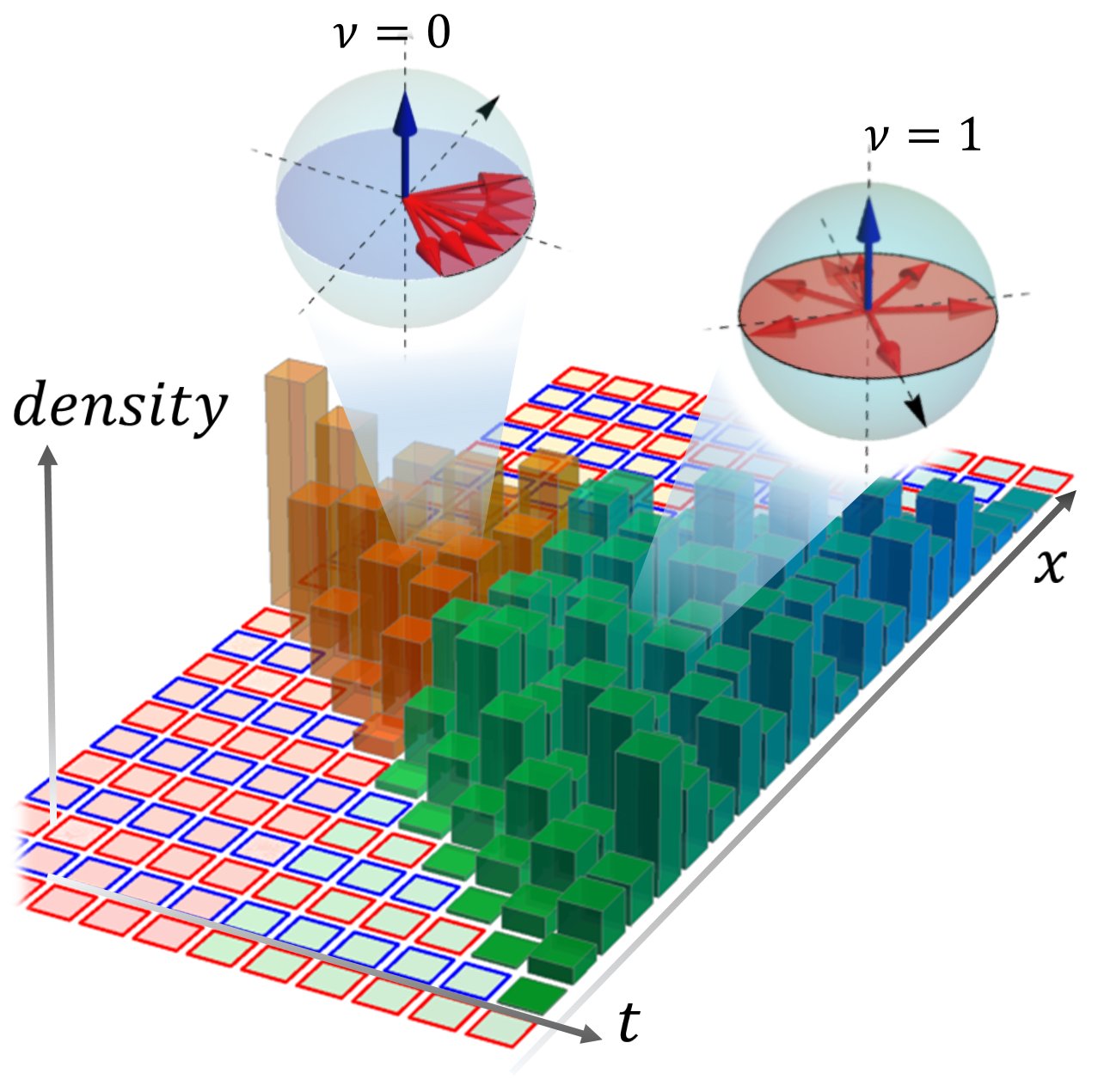
abstract = {The topology of one-dimensional chiral systems is captured by the winding number of the Hamiltonian eigenstates. Here we show that this invariant can be read out by measuring the mean chiral displacement of a single-particle wave function that is connected to a fully localized one via a unitary and translation-invariant map. Remarkably, this implies that the mean chiral displacement can detect the winding number even when the underlying Hamiltonian is quenched between different topological phases. We confirm experimentally these results in a quantum walk of structured light.},

keywords = {},

pubstate = {published},

tppubtype = {article}

}
2019
L. A. Aleman-Castaneda; B. Piccirillo; L. Marrucci; E. Santamato; M. A. Alonso
Tailored shearing interferometry using geometric phase Proceedings Article
In: Optical Design and Fabrication 2019 (Freeform, OFT), 2019.
@inproceedings{<LineBreak>	11588_869033,

title = {Tailored shearing interferometry using geometric phase},

author = {L. A. Aleman-Castaneda and B. Piccirillo and L. Marrucci and E. Santamato and M. A. Alonso},

doi = {10.1364/FREEFORM.2019.JT3B.1},

year  = {2019},

date = {2019-01-01},

urldate = {2019-01-01},

booktitle = {Optical Design and Fabrication 2019 (Freeform, OFT)},

keywords = {},

pubstate = {published},

tppubtype = {inproceedings}

}
A. Pecoraro; F. Cardano; L. Marrucci; A. Porzio
Continuous-variable entangled states of light carrying orbital angular momentum Journal Article
In: PHYSICAL REVIEW A, vol. 100, no. 1, 2019.
@article{<LineBreak>	11588_757176,

title = {Continuous-variable entangled states of light carrying orbital angular momentum},

author = {A. Pecoraro and F. Cardano and L. Marrucci and A. Porzio},

url = {https://www.slam.unina.it/wp-content/uploads/2025/06/pra19.pdf},

doi = {10.1103/PhysRevA.100.012321},

year  = {2019},

date = {2019-01-01},

urldate = {2019-01-01},

journal = {PHYSICAL REVIEW A},

volume = {100},

number = {1},

abstract = {The orbital angular momentum of light, unlike spin, is an infinite-dimensional discrete variable and may hence offer enhanced performances for encoding, transmitting, and processing quantum information. Hitherto, this degree of freedom of light has been studied mainly in the context of quantum states with definite number of photons. On the other hand, field-quadrature continuous-variable quantum states of light allow implementing many important quantum protocols not accessible with photon-number states. Here, we realize a scheme based on a q-plate device for endowing a bipartite continuous-variable Gaussian entangled state with nonzero orbital angular momentum. We then apply a reconfigurable homodyne detector working directly with such nonzero orbital angular momentum modes in order to retrieve experimentally their entire quantum-state covariance matrix, thus providing a full characterization of their quantum fluctuation properties. Our work is a step towards generating multipartite continuous-variable entanglement in a single optical beam.},

keywords = {},

pubstate = {published},

tppubtype = {article}

}
Bereneice Sephton; Angela Dudley; Gianluca Ruffato; Filippo Romanato; Lorenzo Marrucci; Miles Padgett; Sandeep Goyal; Filippus Roux; Thomas Konrad; Andrew Forbes
A versatile quantum walk resonator with bright classical light Journal Article
In: PLOS ONE, vol. 14, no. 4, 2019.
@article{	11588_753405,

title = {A versatile quantum walk resonator with bright classical light},

author = {Bereneice Sephton and Angela Dudley and Gianluca Ruffato and Filippo Romanato and Lorenzo Marrucci and Miles Padgett and Sandeep Goyal and Filippus Roux and Thomas Konrad and Andrew Forbes},

doi = {10.1371/journal.pone.0214891},

year  = {2019},

date = {2019-01-01},

journal = {PLOS ONE},

volume = {14},

number = {4},

abstract = {In a Quantum Walk (QW) the "walker" follows all possible paths at once through the principle of quantum superposition, differentiating itself from classical random walks where one random path is taken at a time. This facilitates the searching of problem solution spaces faster than with classical random walks, and holds promise for advances in dynamical quantum simulation, biological process modelling and quantum computation. Here we employ a versatile and scalable resonator configuration to realise quantum walks with bright classical light. We experimentally demonstrate the versatility of our approach by implementing a variety of QWs, all with the same experimental platform, while the use of a resonator allows for an arbitrary number of steps without scaling the number of optics. This paves the way for future QW implementations with spatial modes of light in free-space that are both versatile and scalable.},

keywords = {},

pubstate = {published},

tppubtype = {article}

}
Thomas Bauer; Peter Banzer; Frédéric Bouchard; Sergej Orlov; Lorenzo Marrucci; Enrico Santamato; Robert W Boyd; Ebrahim Karimi; Gerd Leuchs
Multi-twist polarization ribbon topologies in highly-confined optical fields Journal Article
In: NEW JOURNAL OF PHYSICS, vol. 21, no. 5, 2019.
@article{	11588_757174,

title = {Multi-twist polarization ribbon topologies in highly-confined optical fields},

author = {Thomas Bauer and Peter Banzer and Frédéric Bouchard and Sergej Orlov and Lorenzo Marrucci and Enrico Santamato and Robert W Boyd and Ebrahim Karimi and Gerd Leuchs},

doi = {10.1088/1367-2630/ab171b},

year  = {2019},

date = {2019-01-01},

journal = {NEW JOURNAL OF PHYSICS},

volume = {21},

number = {5},

abstract = {Electromagnetic plane waves, solutions to Maxwell’s equations, are said to be ‘transverse’ in vacuum. Namely, the waves’ oscillatory electric and magnetic fields are confined within a plane transverse to the waves’ propagation direction. Under tight-focusing conditions however, the field can exhibit longitudinal electric or magnetic components, transverse spin angular momentum, or non-trivial topologies such as Möbius strips. Here, we show that when a suitably spatially structured beam is tightly focused, a three-dimensional polarization topology in the form of a ribbon with two full twists appears in the focal volume. We study experimentally the stability and dynamics of the observed polarization ribbon by exploring its topological structure for various radii upon focusing and for different propagation planes.},

keywords = {},

pubstate = {published},

tppubtype = {article}

}
Luis A. Alemán-Castaneda; Bruno Piccirillo; Enrico Santamato; Lorenzo Marrucci; Miguel A. Alonso
Shearing interferometry via geometric phase Journal Article
In: OPTICA, vol. 6, no. 4, 2019.
@article{<LineBreak>	11588_747520,

title = {Shearing interferometry via geometric phase},

author = {Luis A. Alemán-Castaneda and Bruno Piccirillo and Enrico Santamato and Lorenzo Marrucci and Miguel A. Alonso},

doi = {10.1364/OPTICA.6.000396},

year  = {2019},

date = {2019-01-01},

urldate = {2019-01-01},

journal = {OPTICA},

volume = {6},

number = {4},

abstract = {We propose an approach based on geometric phase for per- forming several types of shearing interferometry through a robust, compact, common-path setup. The key elements are two identical parallel plates with spatially varying birefringence distributions, which perform the shearing by writing opposite geometric phases on the two circular polarization components of the linearly polarized incident wavefront. This setup allows the independent control of the shearing magnitude and relative phase of the two wavefront replicas. The approach is first illustrated for the simplest case of lateral shearing, and then extended to other geometries where the magnitude and direction of the shear vary smoothly over the wavefront.},

keywords = {},

pubstate = {published},

tppubtype = {article}

}
Jijil JJ Nivas; Elaheh Allahyari; Filippo Cardano; Andrea Rubano; Rosalba Fittipaldi; Antonio Vecchione; Domenico Paparo; Lorenzo Marrucci; Riccardo Bruzzese; Salvatore Amoruso
Vector vortex beams generated by q-plates as a versatile route to direct fs laser surface structuring Journal Article
In: APPLIED SURFACE SCIENCE, vol. 471, pp. 1028–1033, 2019.
@article{<LineBreak>	11588_726351,

title = {Vector vortex beams generated by q-plates as a versatile route to direct fs laser surface structuring},

author = {Jijil JJ Nivas and Elaheh Allahyari and Filippo Cardano and Andrea Rubano and Rosalba Fittipaldi and Antonio Vecchione and Domenico Paparo and Lorenzo Marrucci and Riccardo Bruzzese and Salvatore Amoruso},

url = {https://www.slam.unina.it/wp-content/uploads/2025/06/ass19postprint.pdf},

doi = {10.1016/j.apsusc.2018.12.091},

year  = {2019},

date = {2019-01-01},

urldate = {2019-01-01},

journal = {APPLIED SURFACE SCIENCE},

volume = {471},

pages = {1028–1033},

abstract = {We report an experimental investigation on direct laser surface structuring with femtosecond vector vortex beams generated by means of q-plates with topological charges q = 1, 3/2, 2, 5/2. Structured light beams with spatially variant state of polarization and intensity are generated and applied to multi-pulse irradiation of a solid crystalline silicon target. The creation of a variety of surface structures, like laser induced periodic surface structures, multi-spot arrays and shaped ablation craters, is demonstrated by direct laser surface structuring with vector vortex beams at different values of q. The features of the surface structures are compared with the vector vortex beam characteristics at the focal plane, evidencing their relationship with the polarization and intensity profile of the laser beams. Our experimental findings show that vector vortex beams produced by q-plates can offer a valuable and versatile route to imprint unconventional surface structures on a solid target through a mask-free ablative process and step scan processing.},

keywords = {},

pubstate = {published},

tppubtype = {article}

}
Taira Giordani; Emanuele Polino; Sabrina Emiliani; Alessia Suprano; Luca Innocenti; Helena Majury; Lorenzo Marrucci; Mauro Paternostro; Alessandro Ferraro; Nicolò Spagnolo; Fabio Sciarrino
Experimental Engineering of Arbitrary Qudit States with Discrete-Time Quantum Walks Journal Article
In: PHYSICAL REVIEW LETTERS, vol. 122, no. 2, 2019.
@article{<LineBreak>	11588_729135,

title = {Experimental Engineering of Arbitrary Qudit States with Discrete-Time Quantum Walks},

author = {Taira Giordani and Emanuele Polino and Sabrina Emiliani and Alessia Suprano and Luca Innocenti and Helena Majury and Lorenzo Marrucci and Mauro Paternostro and Alessandro Ferraro and Nicolò Spagnolo and Fabio Sciarrino},

url = {https://www.slam.unina.it/wp-content/uploads/2025/06/prl19b.pdf},

doi = {10.1103/PhysRevLett.122.020503},

year  = {2019},

date = {2019-01-01},

urldate = {2019-01-01},

journal = {PHYSICAL REVIEW LETTERS},

volume = {122},

number = {2},

abstract = {The capability to generate and manipulate quantum states in high-dimensional Hilbert spaces is a crucial step for the development of quantum technologies, from quantum communication to quantum computation. One-dimensional quantum walk dynamics represents a valid tool in the task of engineering arbitrary quantum states. Here we affirm such potential in a linear-optics platform that realizes discrete-time quantum walks in the orbital angular momentum degree of freedom of photons. Different classes of relevant qudit states in a six-dimensional space are prepared and measured, confirming the feasibility of the protocol. Our results represent a further investigation of quantum walk dynamics in photonics platforms, paving the way for the use of such a quantum state-engineering toolbox for a large range of applications.},

keywords = {},

pubstate = {published},

tppubtype = {article}

}
Bruno Piccirillo; Ester Piedipalumbo; Lorenzo Marrucci; Enrico Santamato
Electrically tunable vector vortex coronagraphs based on liquid-crystal geometric phase waveplates Journal Article
In: MOLECULAR CRYSTALS AND LIQUID CRYSTALS, vol. 684, no. 1, pp. 15–23, 2019.
@article{<LineBreak>	11588_764674,

title = {Electrically tunable vector vortex coronagraphs based on liquid-crystal geometric phase waveplates},

author = {Bruno Piccirillo and Ester Piedipalumbo and Lorenzo Marrucci and Enrico Santamato},

url = {http://www.tandfonline.com/toc/gmcl20/current},

doi = {10.1080/15421406.2019.1581707},

year  = {2019},

date = {2019-01-01},

urldate = {2019-01-01},

journal = {MOLECULAR CRYSTALS AND LIQUID CRYSTALS},

volume = {684},

number = {1},

pages = {15–23},

keywords = {},

pubstate = {published},

tppubtype = {article}

}
Vincenzo D’Ambrosio; Gonzalo Carvacho; Iris Agresti; Lorenzo Marrucci; Fabio Sciarrino
Tunable Two-Photon Quantum Interference of Structured Light Journal Article
In: PHYSICAL REVIEW LETTERS, vol. 122, no. 1, 2019.
@article{<LineBreak>	11588_727566,

title = {Tunable Two-Photon Quantum Interference of Structured Light},

author = {Vincenzo D’Ambrosio and Gonzalo Carvacho and Iris Agresti and Lorenzo Marrucci and Fabio Sciarrino},

url = {https://www.slam.unina.it/wp-content/uploads/2025/06/prl19.pdf},

doi = {10.1103/PhysRevLett.122.013601},

year  = {2019},

date = {2019-01-01},

urldate = {2019-01-01},

journal = {PHYSICAL REVIEW LETTERS},

volume = {122},

number = {1},

abstract = {Structured photons are nowadays an important resource in classical and quantum optics due to the richness of properties they show under propagation, focusing, and in their interaction with matter. Vectorial modes of light in particular, a class of modes where the polarization varies across the beam profile, have already been used in several areas ranging from microscopy to quantum information. One of the key ingredients needed to exploit the full potential of complex light in the quantum domain is the control of quantum interference, a crucial resource in fields like quantum communication, sensing, and metrology. Here we report a tunable Hong-Ou-Mandel interference between vectorial modes of light. We demonstrate how a properly designed spin-orbit device can be used to control quantum interference between vectorial modes of light by simply adjusting the device parameters and no need of interferometric setups. We believe our result can find applications in fundamental research and quantum technologies based on structured light by providing a new tool to control quantum interference in a compact, efficient, and robust way.},

keywords = {},

pubstate = {published},

tppubtype = {article}

}

Andrea Rubano; Filippo Cardano; Bruno Piccirillo; Lorenzo Marrucci
Q-plate technology: a progress review Journal Article
In: JOURNAL OF THE OPTICAL SOCIETY OF AMERICA. B, OPTICAL PHYSICS, vol. 36, no. 5, 2019.
@article{<LineBreak>	11588_742902,

title = {Q-plate technology: a progress review},

author = {Andrea Rubano and Filippo Cardano and Bruno Piccirillo and Lorenzo Marrucci},

url = {https://www.slam.unina.it/wp-content/uploads/2025/06/josab19.pdf},

doi = {10.1364/JOSAB.36.000D70},

year  = {2019},

date = {2019-01-01},

urldate = {2019-01-01},

journal = {JOURNAL OF THE OPTICAL SOCIETY OF AMERICA. B, OPTICAL PHYSICS},

volume = {36},

number = {5},

abstract = {Since their first introduction in 2006, q-plates have found a constantly increasing number of uses in diverse contexts, ranging from fundamental research on complex structured light fields to more applicative innovations of established experimental techniques, passing through a variety of other emerging topics, such as, for instance, quantum information protocols based on the angular momentum of light. In this paper, we present a bird’s-eye view of the progress of this technology in recent years and offer some educated guesses on the most likely future developments.},

keywords = {},

pubstate = {published},

tppubtype = {article}

}

P Gregg; P Kristensen; A Rubano; S Golowich; L Marrucci; S Ramachandran
Enhanced spin orbit interaction of light in highly confining optical fibers for mode division multiplexing Journal Article
In: NATURE COMMUNICATIONS, vol. 10, no. 1, 2019.
@article{<LineBreak>	11588_764206,

title = {Enhanced spin orbit interaction of light in highly confining optical fibers for mode division multiplexing},

author = {P Gregg and P Kristensen and A Rubano and S Golowich and L Marrucci and S Ramachandran},

doi = {10.1038/s41467-019-12401-4},

year  = {2019},

date = {2019-01-01},

urldate = {2019-01-01},

journal = {NATURE COMMUNICATIONS},

volume = {10},

number = {1},

abstract = {Light carries both orbital angular momentum (OAM) and spin angular momentum (SAM), related to wavefront rotation and polarization, respectively. These are usually approximately independent quantities, but they become coupled by light's spin-orbit interaction (SOI) in certain exotic geometries and at the nanoscale. Here we reveal a manifestation of strong SOI in fibers engineered at the micro-scale and supporting the only known example of propagating light modes with non-integer mean OAM. This enables propagation of a record number (24) of states in a single optical fiber with low cross-talk (purity > 93%), even as tens-of-meters long fibers are bent, twisted or otherwise handled, as fibers are practically deployed. In addition to enabling the investigation of novel SOI effects, these light states represent the first ensemble with which mode count can be potentially arbitrarily scaled to satisfy the exponentially growing demands of high-performance data centers and supercomputers, or telecommunications network nodes.},

keywords = {},

pubstate = {published},

tppubtype = {article}

}
A. Rubano; S. Mou; L. Marrucci; D. Paparo
Terahertz Hyper-Raman Time-Domain Spectroscopy Journal Article
In: ACS PHOTONICS, vol. 6, no. 6, pp. 1515–1523, 2019.
@article{<LineBreak>	11588_757178,

title = {Terahertz Hyper-Raman Time-Domain Spectroscopy},

author = {A. Rubano and S. Mou and L. Marrucci and D. Paparo},

url = {http://pubs.acs.org/journal/apchd5},

doi = {10.1021/acsphotonics.9b00265},

year  = {2019},

date = {2019-01-01},

urldate = {2019-01-01},

journal = {ACS PHOTONICS},

volume = {6},

number = {6},

pages = {1515–1523},

abstract = {A new spectroscopic method has been demonstrated on the benchmark crystal α-SiO2. The new technique makes use of femtosecond optical pulses and intense, sub-ps, broadband terahertz (THz) pulses to generate a THz-optical four wave mixing in the investigated material. The spectrum of the generated signal is resolved in wavelength and displays two pronounced frequency sidebands close to the optical second harmonic central frequency 2ωL, where ωL is the optical central frequency of the fundamental beam. The two sidebands develop around the central frequency at the (anti-) Stokes side of ωs;a = 2ωL ∓ ωT, where ωT is the THz central frequency, thus resembling the spectrum of standard hyper-Raman scattering, and hence, we named this effect “THz Hyper-Raman” - THYR. Due to the large laser and THz bandwidths, it is not possible to resolve the THYR signal in the frequency domain. Nonetheless, by taking advantage of the same principle at work in THz time-domain spectroscopy, it is possible to follow the evolution of the THYR signal in time and access the frequency domain again by Fourier Transform. In this way we were able to observe pronounced oscillations in time of the THYR signal whose frequencies correspond to a large variety of material excitations including Γ-point phonons, polaritons, and phonons out of the Γ-point, which are usually observed only by neutron scattering techniques. To complement the richness of these observations, we will show that the selection rules of the THYR process allow the simultaneous observation of both IR- and Raman-active material modes, thus highlighting the potential of this innovative experimental method.},

keywords = {},

pubstate = {published},

tppubtype = {article}

}
2018
Filippo Cardano; Alessio D'Errico; Bruno Piccirillo; Lorenzo Marrucci
Apparatus for two-dimensional photonic simulation by means of Pancharatnam-Berry phase plates Patent
2018.
@patent{11588_880886,

title = {Apparatus for two-dimensional photonic simulation by means of Pancharatnam-Berry phase plates},

author = {Filippo Cardano and Alessio D'Errico and Bruno Piccirillo and Lorenzo Marrucci},

year  = {2018},

date = {2018-01-01},

urldate = {2018-01-01},

keywords = {},

pubstate = {published},

tppubtype = {patent}

}