
Structured Photons
We engineer the spatial and polarization degrees of freedom of light to implement quantum simulations, topological photonics and programmable high-dimensional optical circuits.
We use transverse spatial modes and polarization to encode and manipulate optical information. These modes include optical vortices carrying orbital angular momentum. Their coherent control provides a free-space platform for quantum simulation and the study of complex photonic dynamics.
Research lines
Spatial modes and orbital angular momentum
We generate and manipulate transverse optical modes with controlled amplitude, phase and orbital angular momentum for classical and quantum applications.
Photonic quantum simulation
We implement one- and two-dimensional photonic quantum walks to simulate quantum dynamics and explore models that are difficult to access in other experimental systems.
Topological and non-Hermitian photonics
We control photonic evolution to investigate topological phases and non-Hermitian dynamics in programmable optical systems.
High-dimensional photonic circuits
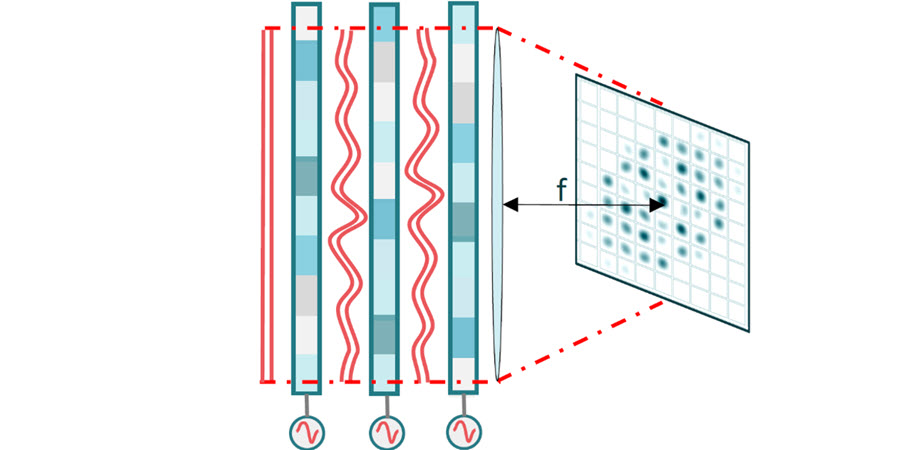
We combine liquid-crystal metasurfaces and spatial light modulators to build programmable free-space circuits, implement complex transformations of optical modes and develop quantum imaging schemes.
Selected publications
- High-dimensional programmable photonic circuits with structured mediaM. G. Ammendola, N. Dehghan, L. Scarfe, A. D’Errico, F. Di Colandrea, E. Karimi and F. Cardano, arXiv:2506.09802 (2025).
- Programmable non-Hermitian photonic quantum walks via dichroic metasurfacesP. Savarese, S. Bansal, M. G. Ammendola, L. Amato, R. Barboza, B. Piccirillo, F. Di Colandrea, L. Marrucci and F. Cardano, arXiv:2503.05072 (2025).
- Large-scale free-space photonic circuits in two dimensionsM. G. Ammendola, F. Di Colandrea, L. Marrucci and F. Cardano, Advanced Photonics 7, 016006 (2025).
- Ultra-long photonic quantum walks via spin-orbit photonicsF. Di Colandrea, A. Babazadeh, A. Dauphin, P. Massignan, L. Marrucci and F. Cardano, Optica 10, 324–331 (2023).
Explore SLAM
This group is part of SLAM, a cluster of three independent research groups with shared scientific interests and resources.